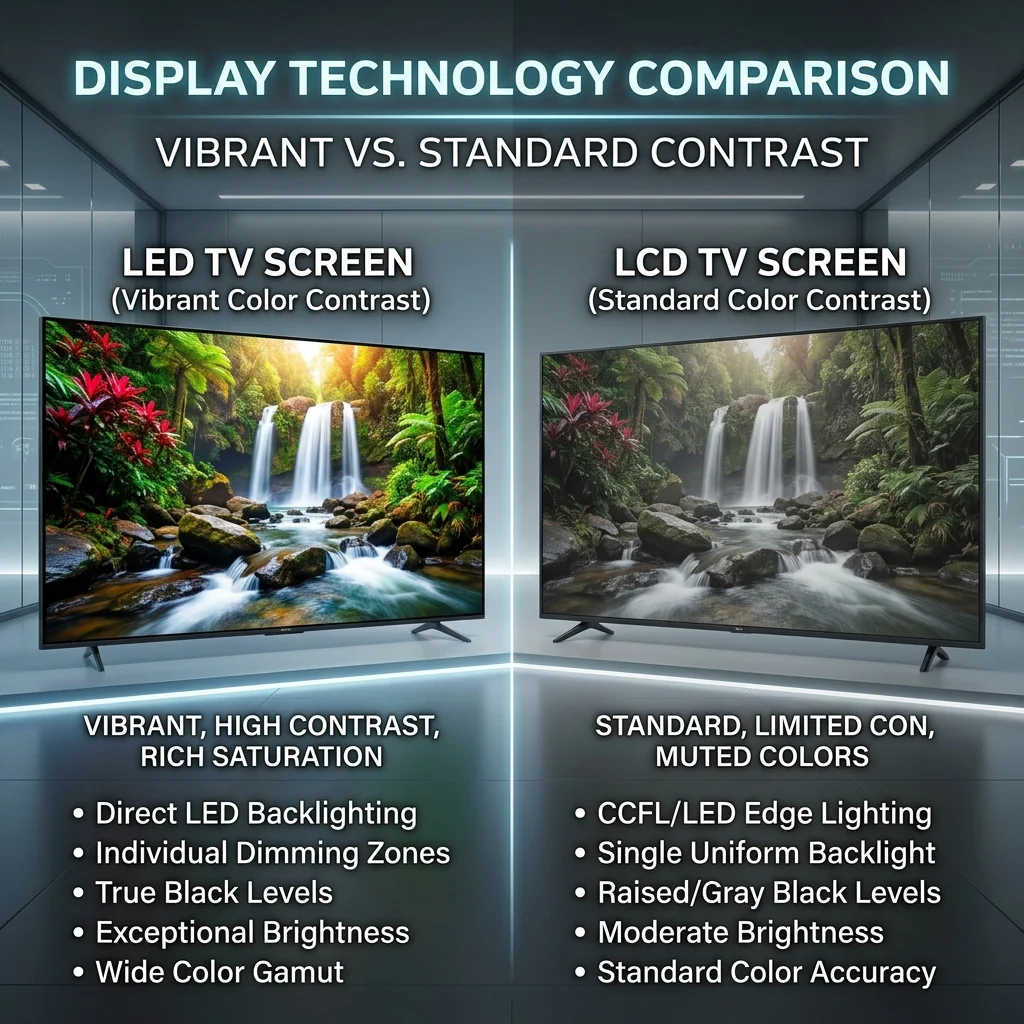
When shopping for a new television or dealing with a broken screen, you will constantly hear the terms "LED" and "LCD." While salesmen present them as entirely different technologies, the truth is simpler: an LED TV is actually a type of LCD TV.
Both types rely on Liquid Crystal Displays (LCD) to construct the image you see on screen, but they differ fundamentally in how they light up that screen. In this article, our senior technicians at R.R. Electronics explain the core technology differences, picture quality, energy consumption, and—most importantly—how their repair costs differ when something goes wrong.
The Core Technology Difference: Backlights
Liquid crystals do not produce their own light. They act like tiny shutters, opening and closing to let light pass through or block it to form colors. Therefore, all LCD screens require a separate light source behind them—called a backlight.
- Standard LCD TVs (Cold Cathode Fluorescent Lamps - CCFL): Traditional LCD TVs use thin fluorescent tubes behind the screen. These lamps are bulkier, run hotter, and take time to reach full brightness. CCFL LCD TVs are mostly discontinued now but are still active in many homes.
- LED TVs (Light Emitting Diodes): LED TVs replace the fluorescent lamps with rows of miniature LEDs. These diodes are smaller, run much cooler, and can be dimmed individually to create deeper blacks and superior contrast.
💡 Key takeaway: Every LED TV is an LCD TV, but not every LCD TV is an LED TV. The difference lies solely in the lighting element—fluorescent lamps vs. light-emitting diodes.
Display Quality Comparison
Because LED backlights consist of hundreds of independent light sources, they offer several major picture quality advantages:
- Black Levels and Contrast: LED backlights can be localized (known as Local Dimming). If a scene is dark on one side, the LEDs in that region turn off completely, achieving true blacks. Traditional LCD TVs cannot do this, resulting in a dark gray tone.
- Color Saturation: LEDs offer a wider, richer spectrum of colors, making scenes appear more realistic and vibrant.
- Brightness: LEDs can produce much higher peak brightness, making them ideal for well-lit rooms and HDR content.
Comparative Repair Costs & Common Failures
When hardware components fail, the differences in backlighting and layout drastically affect repair methods and costs. Below is a breakdown of common failures and what you can expect to pay for a repair.
1. Backlight Failure
If your TV has sound but no picture, or if the screen is very dim (visible only when you point a phone flashlight at it), the backlighting is broken.
- In LCD TVs: CCFL bulbs are delicate and require high-voltage inverters to run. When a bulb burns out, it must be replaced, which can be difficult to source for older models. Repair costs range from ₹1,000 to ₹2,000.
- In LED TVs: LED strips are wired in a series circuit. If one diode burns out, the entire strip (or all backlights) stops working. Technicians must open the screen chassis and replace the complete set of LED strips. Typical repair costs start from ₹1,500 to ₹3,500, depending on screen size.
2. Motherboard & Power Board Failures
If the TV fails to turn on, displays a blinking standby light, or restarts continuously, there is likely a component failure on the power board or motherboard.
- Because LED TVs run on lower voltage and draw less power, their power boards are less prone to heat damage compared to heavy LCD TV power supplies. However, modern Smart LED TVs have complex motherboards that are sensitive to voltage surges.
- Repairing these components starts from ₹1,200, while full card replacements range between ₹2,500 and ₹6,000 depending on the brand and model.
Quick Tech Comparison & Repair Overview
| Feature / Parameter | CCFL LCD TV | LED TV |
|---|---|---|
| Light Source | Fluorescent Tubes (CCFL) | Light Emitting Diodes (LED) |
| Thickness / Design | Bulky and Heavy | Sleek and Ultra-Thin |
| Energy Efficiency | Moderate to Low | Highly Efficient (saves up to 40% power) |
| Common Issue | Inverter Board failure / Dull Screen | LED Backlight strip burnout |
| Average Repair Cost | ₹1,000 – ₹2,500 | ₹1,500 – ₹4,500 (strips or power) |
Should You Repair or Replace?
If you own an older LCD TV that has suffered screen cracking or backlight failure, replacing it with a new LED or Smart TV is usually the most cost-effective path. Finding replacement parts for CCFL LCDs is becoming increasingly difficult.
However, if you have a modern LED or Smart TV, a backlight strip failure or motherboard issue is highly repairable at a fraction of the cost of a new TV. A professional repair by R.R. Electronics will restore your TV to original brightness and add years to its operational lifespan.