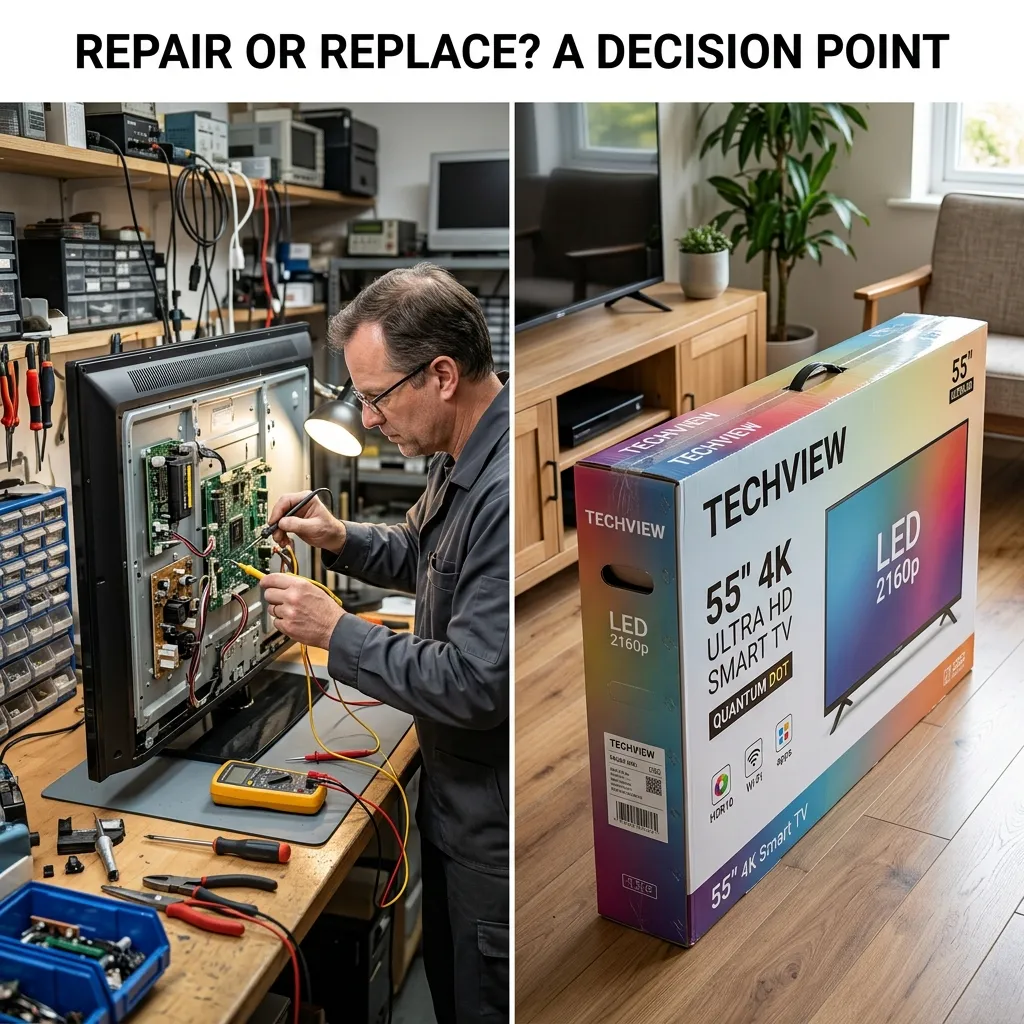
We repair televisions for a living, so you would expect this article to conclude that you should always repair your television. It does not.
A meaningful share of the sets we are called out to look at are not worth fixing, and we say so on the spot. We would rather lose one job and be the people you call — and recommend — for the next fifteen years. So here is the framework we actually use, and you can apply it before anyone quotes you anything.
The 40% rule
One line, and it settles most cases:
If the repair costs more than about 40% of what an equivalent new television costs today, replace it.
Why 40 and not 50? Because a repaired television is not a new one. Your repaired set has whatever years it already has on the clock, a short repair warranty rather than a full manufacturer warranty, and other components that have aged alongside the one that failed. A new TV resets all three. That gap is worth roughly ten percentage points, which is why the honest threshold sits below half.
Two adjustments to the rule:
- Push the threshold up if the set is genuinely premium — a large-format or high-end panel only two or three years old is worth more effort, because the equivalent new set is expensive and your existing one still has a lot of life left.
- Push it down if the TV is old, small, or has already been repaired once for something unrelated. Multiple aging components mean the next failure is not far away.
The repairs that are almost always worth it
These faults share one thing: the panel — which holds most of the television's value — is untouched. You are fixing a supporting component in an otherwise healthy set, and the cost is a small fraction of replacement.
| Fault | Why It's Worth Repairing |
|---|---|
| Power supply / SMPS board | Frequently just failed capacitors. A component-level repair on a healthy TV. More → |
| LED backlight strips | The panel and boards are all fine — you're replacing a lamp. More → |
| No sound / distorted audio | Usually a blown amplifier IC or a speaker. Among the cheapest fixes. More → |
| T-CON board | A board swap. Moderate cost, restores a fully working display. |
| Motherboard faults | Often repairable at component level rather than replaced wholesale. More → |
| HDMI ports, Wi-Fi module, loose ribbons | Small, contained, inexpensive. |
If a technician tells you a television with one of these faults should be scrapped, get a second opinion. That is not a diagnosis, it is a sales pitch for someone's brother-in-law's electronics shop.
The one that usually isn't worth it
Panel replacement.
The LCD/LED panel is not a component in the television — for costing purposes, it very nearly is the television. It routinely represents more than half the retail price of the whole unit. Add the labour, and the real risk of cracking a large sheet of tensioned glass during the swap, and a panel replacement frequently lands within a few thousand rupees of simply buying a new set with a full manufacturer warranty.
So if your screen is physically cracked, has a spiderweb impact pattern, or shows thin fixed vertical lines caused by failed drivers bonded onto the glass, our honest answer for most televisions is: put the money towards a new one. The exception is a genuinely premium, genuinely young set — there the maths can flip. We explain the full reasoning on our panel replacement page, and how to read the symptoms in lines on your TV screen.
Beyond the money: three questions worth asking
Cost is not the only input. Three more things genuinely matter:
Does the set still do what you need?
A well-built 1080p television that has been reliable for years is not obsolete just because 4K exists. If you are happy with the picture and you sit at a normal viewing distance, a repair keeps a good thing going. But if you have been quietly wanting a bigger screen or a modern smart platform for two years, a major fault is a reasonable moment to stop spending on the old one.
Has it failed before?
One failure is bad luck. A second, unrelated failure within a year or two is a signal — heat, voltage, or age is working through the whole board set, and you are likely to be back here again soon. Two strikes is usually where we start advising replacement even when the individual repair is cheap.
What is the environmental answer?
Worth saying plainly: a television repaired for a modest sum is one less large piece of e-waste, and India has a lot of it. Where the numbers are close, repairing is the better call. Where a panel replacement is only marginally cheaper than a new set, it is not — you would be spending nearly full price to keep an aging chassis alive.
Before you decide, get a real diagnosis
Every number in this article is meaningless until you know which fault you have. Remember that "sound but no picture" can be a cheap loose cable or a dead panel — same symptom, wildly different verdict. You cannot make this decision from your sofa, and neither can a technician on the phone.
Anyone who quotes you a firm price before opening the television is either guessing or setting up a revised bill later. Insist on a doorstep diagnosis, ask what specifically failed, and ask for the repair-versus-replace recommendation in the same breath as the quote. Our guide to TV repair costs in Delhi covers what a fair quote looks like and the five ways people get overcharged.
Who we are
RR Electronics is an independent, third-party out-of-warranty repair service in New Delhi, working since 2011. We are not an authorised service centre for any brand and hold no affiliation with any manufacturer — see our full disclaimer. If your television is still under manufacturer warranty, go to the brand's own service centre: it will be free, and letting an independent shop open the set voids that warranty.
If it is out of warranty, we will come to your home anywhere in Delhi, tell you exactly what failed, and tell you honestly whether it is worth your money — including when the answer is no.