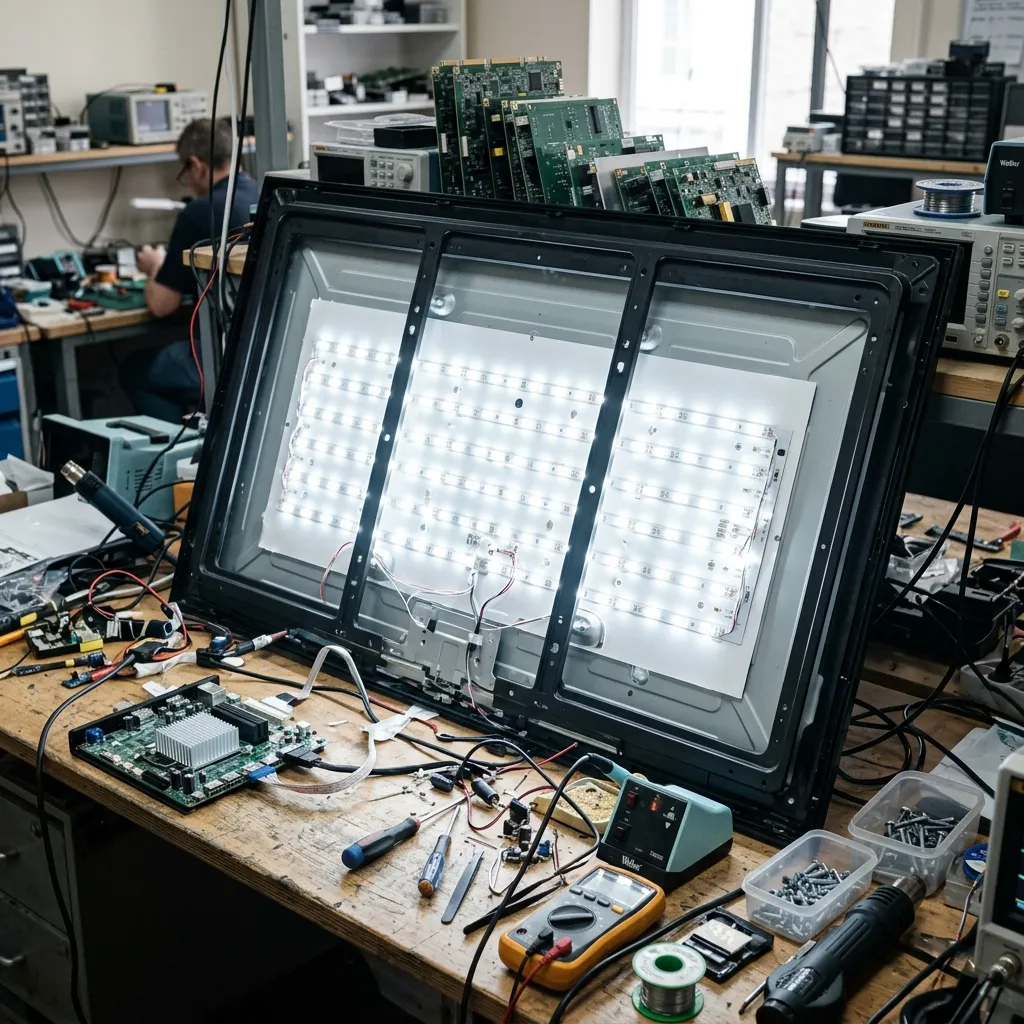
If your LED TV has gone dark but the sound still plays perfectly, there is a good chance you have a backlight failure — and that is genuinely one of the better outcomes. It is repairable, it is affordable relative to the value of the set, and everything else in your television is almost certainly fine.
Here is what is actually happening inside the box.
Your TV screen does not produce light
This surprises most people. An LED television's panel is not a light source. It is a shutter — millions of tiny liquid-crystal gates that block or allow light, and colour filters that tint it. It produces the image, but it has no brightness of its own.
The light comes from a completely separate component: an array of small white LEDs mounted on metal strips, sitting behind the panel. This is the backlight. It is, in effect, a lamp with a picture painted on the glass in front of it.
When that lamp burns out, the picture is still being drawn — perfectly, in full colour, at full frame rate. There is just nothing illuminating it. Your TV is working. You simply cannot see it.
💡 This is why the torch test works. In a dark room, shine a phone torch at a steep angle onto the screen while the TV is on. If you can faintly make out a greyish image or the menu, your panel and all your boards are alive — your backlight has died. Your torch is temporarily doing the backlight's job.
Why LED strips die
Three reasons, in order of how often we see them:
1. Heat — the main killer
LEDs degrade with heat, and a television is a sealed box with limited ventilation. Every hour of viewing is an hour of thermal stress. In Delhi's summers, a TV in a room without air conditioning, mounted flat against a wall with no air gap, runs hot for months on end. That is the single biggest thing that shortens backlight life.
2. The series-string problem
Here is the cruel design detail: backlight LEDs are wired in series strings, like old Christmas lights. Ten or fifteen LEDs share one circuit. When a single LED fails open, the entire string goes dark — a dozen perfectly healthy LEDs stop lighting because of one dead neighbour.
This is why backlight failure often shows as dark patches or a dark half of the screen before it goes fully black, and why a fault in one small component can take out a large area of your display.
3. Voltage stress
Backlights are driven at high voltage by the power supply board. An unstable mains supply — familiar to anyone in Delhi — stresses both the driver circuit and the LEDs themselves. A good voltage stabiliser genuinely extends backlight life. It is one of the cheapest pieces of insurance you can buy for a television.
How backlight repair actually works
It is a delicate job rather than a difficult one, and it is where most of the risk in TV repair lives:
- The TV is laid face-down on a padded surface and the rear housing removed.
- The boards and ribbon cables are disconnected and set aside.
- The bezel is removed and the panel is lifted out — this is the dangerous step. The panel is a large, thin sheet of glass under tension. Lifted unevenly, it cracks, and a cracked panel turns a modest repair into a total write-off.
- The diffuser sheets beneath it are removed in order (they must go back in the same order or the picture develops bright and dark patches).
- The failed LED strips are identified, the old ones removed, and new strips fitted and reseated onto the thermal backing.
- Everything goes back in reverse, and the set is tested at several brightness levels before it is closed.
Two things follow from this. First, this is not a DIY job — not because it is clever, but because one wrong lift of the glass costs you the television. Second, ask any technician whether they replace all the strips or just the failed ones. Replacing only the dead strip is cheaper today and often means a second failure within a year, because the surviving strips have the same age and the same heat history. We generally recommend replacing the full set.
See our LED TV repair page for current pricing, which scales with screen size — a 32-inch set uses far fewer strips than a 55-inch.
Is it worth repairing?
Almost always, yes. This is one of the few TV faults where we can say that without hedging.
Backlight replacement costs a modest fraction of a new television, and when the backlight is what failed, everything else — the panel, the main board, the T-CON, the processor — is typically in good order. You are replacing a lamp in an otherwise healthy set. Compare that to a panel replacement, where the part alone can exceed half the price of a new TV and we will usually advise you not to bother.
If you want the full financial reasoning, we wrote it up in TV repair or replace, and the price landscape in TV repair cost in Delhi.
Making the next backlight last longer
- Turn the backlight setting down. Not "brightness" — look for the separate Backlight or OLED Light slider. Most TVs ship at or near maximum for showroom appeal. Dropping it to 60–70% is barely noticeable indoors and meaningfully reduces heat.
- Leave an air gap. If wall-mounted, use a bracket that stands the TV off the wall. Never box a television into a tight cabinet.
- Use a stabiliser. Especially if your area sees voltage swings.
- Actually switch it off. Standby still draws power and the panel still warms. A TV left on for background noise is being aged for nothing.
- Enable the ambient light sensor if your set has one, so it dims itself in the evening.
Our guide on extending your TV's lifespan covers the rest.
Getting it diagnosed
RR Electronics is an independent, third-party out-of-warranty repair service in New Delhi. We are not an authorised service centre for any brand and are not affiliated with any manufacturer — our disclaimer spells this out. If your TV is still under manufacturer warranty, use the brand's service centre; it will be free, and letting us open it would void that warranty.
If it is out of warranty and dark, we will do the torch test with you at your door in Delhi and tell you exactly what failed before we quote.